Aftermath of Ethnic Conflict and Displacement
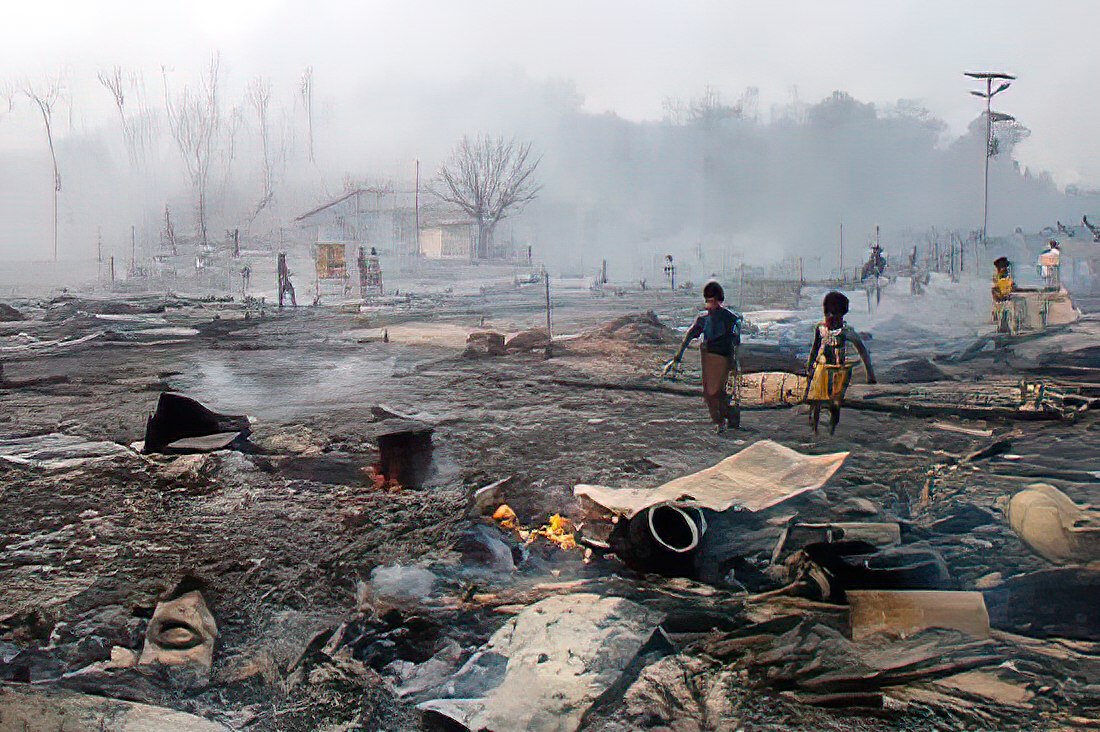
The image, cloaked in smoke and debris, captures a haunting moment in the aftermath of ethnic conflict. Children wander through what was once their home—now reduced to ash and ruin. This is not an isolated scene; it is a repeated tragedy that continues to unfold across the globe. From the burned villages of Myanmar’s Rakhine State to war-torn regions of South Sudan, and from the mass graves of Bosnia to the refugee camps bordering Ethiopia and Eritrea, the world has witnessed the horrific cost of ethnic hatred and the systematic denial of human rights.
"Aftermath of Ethnic Conflict and Displacement" is more than a description—it is a global humanitarian crisis. Ethnic violence arises when divisions are inflamed by power struggles, economic inequality, or historic grievances. It often leads to targeted attacks on specific communities through arson, forced removal, sexual violence, and mass killings. These atrocities are classified under international law as crimes against humanity or, in the worst cases, genocide.
The human cost of ethnic conflict is immeasurable. Families are torn apart, communities obliterated, and survivors left to navigate trauma with little to no support. Displacement is a common outcome, with millions forced to flee across borders or live in makeshift camps within their own countries. These internally displaced persons (IDPs) and refugees often face hunger, lack of medical care, and limited access to education or employment.
While international conventions—such as the Geneva Conventions, the Genocide Convention, and the Universal Declaration of Human Rights—are in place to protect civilians, enforcement remains inconsistent. The role of the international community is often reactive rather than preventative, and political alliances or economic interests frequently stall meaningful intervention.
Justice remains elusive for many victims. Truth and reconciliation commissions, war crimes tribunals, and international courts exist, but access to them is often slow or denied. Meanwhile, survivors must rebuild with limited resources and little acknowledgment of the horrors they’ve endured. Entire generations may grow up in exile, separated from their cultural heritage and disconnected from any sense of national belonging.
Yet, in the rubble, there is resistance. Survivors become activists, displaced communities form solidarity networks, and youth rise with hope and education as tools for change. Civil society organizations document abuses, advocate for reparations, and pressure governments for accountability. It is within this activism that the possibility for healing and long-term peace begins.
As we reflect on the devastation captured in this image, we are reminded that ethnic conflict is not inevitable—it is the result of human choices. Our responsibility lies in making different ones: by promoting inclusive governance, dismantling systems of oppression, and standing against hate wherever it arises. Protecting human rights is not optional; it is the only path forward to a just and peaceful world.